- Recorded local reception
- Reconstructed Stardate · declared zero
STARDATE SIML / A GALACTIC CALENDAR CONCEPT
A common beat.
A shared reference.
Count hydrogen cycles. Choose a documented zero. Give distant observers a common language for the history they share.
A proposed calendar convention and an executed synthetic research lab. The black-hole rewind is an imaginative definition of zero—not a measured formation date.
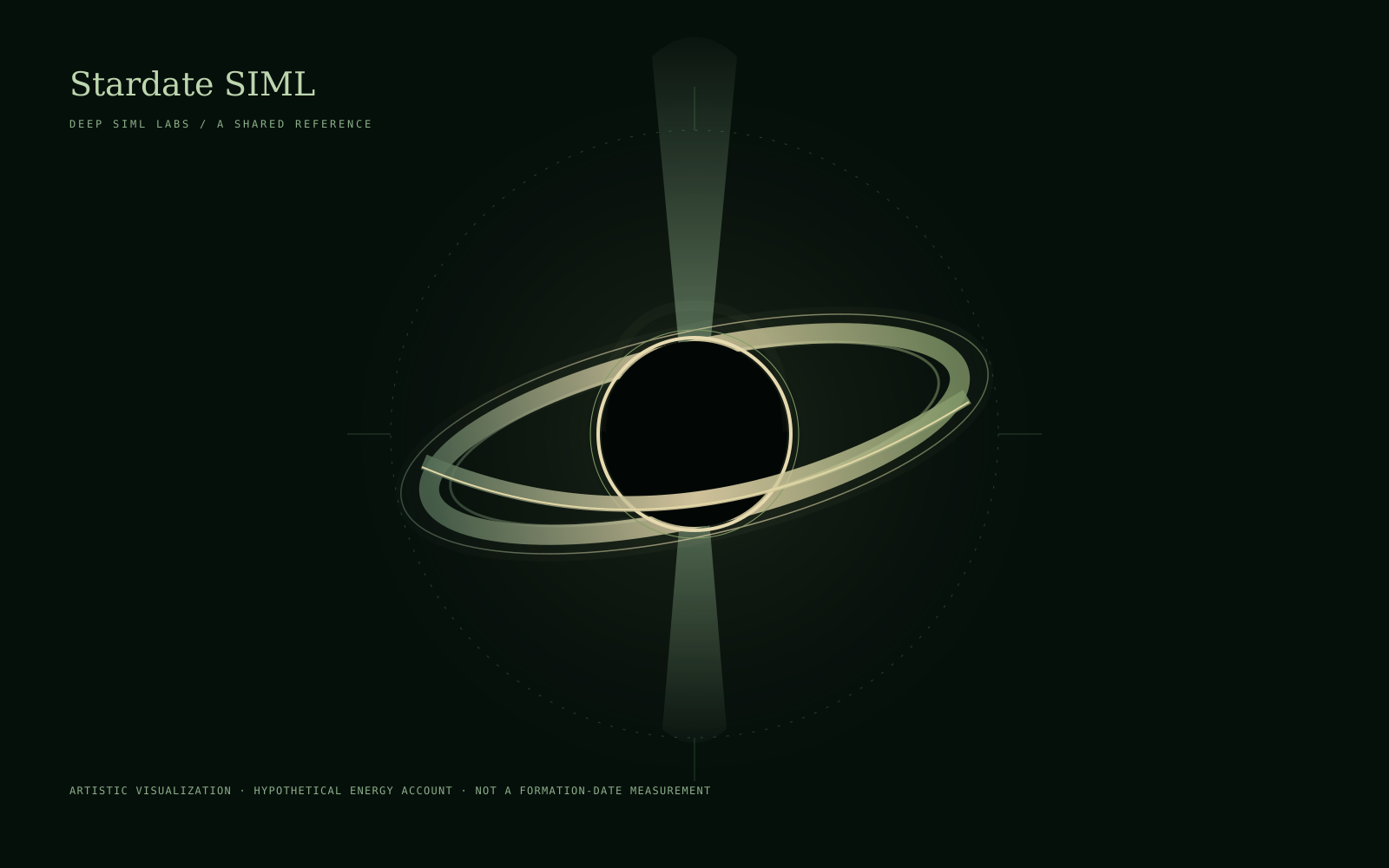
SAGITTARIUS A* / ARTISTIC VISUALIZATIONILLUSTRATIVE ENERGY FLOW
HYDROGEN REFERENCE00 fractional cycle · phase display slowed
ILLUSTRATIVE LINEAR ENERGY ACCOUNT
Reference stateDefined zero
- Rewound interval
- Illustrative energy remaining
- Frozen energy-flow assumption
01 Hydrogen-cycle unit02 Explicit galactocentric frame03 Versioned calendar zero
01 / A DEFINITION YOU CAN REWIND
Set the counter.
Keep the assumptions visible.
Imagine an energy account for the Galactic Center. Rewind a fixed, fictional energy flow until that account reads zero. That point can name a calendar origin—even though it does not tell us when the black hole formed.
THE CONVENTION
The scientific description and sign convention
This display is an explicitly defined linear energy ledger. It uses a reference mass scale and a frozen assumed power. The shrinking disk is an artistic rule driven by the account’s remaining fraction. It is not an accretion simulation, a reconstruction of the event horizon, or a measured polar-emission history.
THE IDEA IN MOTION
From one beat
to a shared history.
A visual introduction to the hydrogen reference, a chosen calendar origin, and the corrections two observers need before their dates can agree.
Read the accessible transcript
Stardate SIML explores a shared calendar for distant observers. A hydrogen reference supplies the counting unit. A separately declared coordinate frame supplies orientation and time semantics. A fixed fictional energy rewind supplies one possible calendar zero.
That zero is chosen, not discovered as the birth of Sagittarius A*. Each observer still measures local proper time. Clock calibration, motion, gravity, and signal travel must be accounted for before comparing event dates.
Our synthetic laboratory demonstrates why a black hole’s present mass can fit different growth histories. A stable operational calendar can preserve archived timestamps while uncertain historical mappings improve.
Download the complete film transcript02 / TWO WORLDS, ONE EVENT
The same flash.
Different local experiences.
Like hearing thunder from different distances, each observer receives the same event after a different journey. Convert the local clock reading. Subtract the signal delay. Then express the event in the shared calendar.
INDEPENDENT PERSISTED OBSERVER RECORDSSCHEMATIC / NOT TO SCALE
- Recorded local reception
- Reconstructed Stardate · declared zero
01
Count locally.
One hydrogen reference cycle defines the protocol’s tick. Partial cycles remain part of the timestamp.
02
Correct the journey.
Clock calibration, local rate, and light-travel corrections connect the received signal with its emission event.
03
Use the same zero.
The epoch and frame are exchanged as a versioned record. A common unit alone does not supply either one.
Hydrogen ticks, proper time, and coordinate time
The static toy model uses q = (1 + ε)α: calibrated hardware rate times proper-time rate. In a changing-rate model, the clock map must be integrated and inverted. The proposed frame uses galactocentric, nonrotating axes; hydrogen cycles set a duration unit, not a spatial orientation.
03 / THE RESEARCH BEHIND THE CONCEPT
Explore the evidence.
Keep the unknowns.
The calendar concept sits beside a reproducible laboratory. These plots load frozen results. Changing a selector explores an executed case; it does not fit a new history in your browser.
Recorded software checks
Matched synthetic interval coverage
Deliberate mismatch control
Persisted research run
Coverage applies to the predeclared identifiable toy case. It does not establish physical dating accuracy for Sagittarius A* or for this fictional energy-zero convention.
Inspect the data and provenance04 / A CALENDAR FOR WHAT WE REMEMBER
Keep the record.
Improve the interpretation.
An archive needs stable identifiers, original timestamps, source locations, and versioned transformations. New research about a black hole’s past should improve the historical mapping without silently moving every event in the archive.
ARCHIVE / OPERATIONAL LAYER
“When was this recorded?”
The original clock reading, source, coordinate model, uncertainty, and epoch-definition version stay attached to the event.
RESEARCH / HISTORICAL LAYER
“What did this mean in the galaxy’s history?”
Model-dependent black-hole ages, assembly histories, and cosmological mappings remain separately versioned and uncertain.
No real human event has been converted to a galactic date in this demonstration. A future application must preserve and justify the relevant Earth, spacecraft, and galactic coordinate transformations.
OPEN METHODS / REVIEW-READY
Built to be examined.
Paper and code.
Separate the product interface, the versioned convention, and the frozen research data. Review the assumptions and failure cases. Reproduce the numerical results before treating a calendar proposal as a scientific finding.
Read the pre-release paper and explore the open-source repository. The paper is not peer reviewed.
A present-day scale, with uncertainty.
A model-derived upstream summary is not a raw independent likelihood, a lifetime growth record, or a birth-date measurement.
Executed models, preserved failures.
No synthetic ancient observation is presented as a real record. All stellar events and observer fixtures in this experience are synthetic.