Capability white paper · Not peer reviewed. Measured on one NVIDIA GeForce RTX 3060 with 12 GiB VRAM. The public release contains the paper and explanatory figures; implementation and raw research artifacts remain private.
More work from a fixed memory budget
Many computational models repeatedly update large collections of small states. Their useful scale depends on how much state fits in memory and how efficiently the computer can update it. Deep SIML Labs investigated those questions using a deliberately narrow benchmark: binary lattice Gibbs sampling, where each site has two possible states and interacts with its nearest neighbors.
The strongest matched comparison delivered 12.08× faster resident updates than a separately tuned UInt8 CUDA control, with a pointwise 95% paired-bootstrap interval of 11.82–12.70×. In a separate sustained test, one connected lattice containing 84.26 billion binary state variables completed about 2.97 full sweeps per second for at least 600 measured seconds. These are two different measurements, with different populations and purposes.
What the experiment actually updates
The target is a periodic three-dimensional lattice. A site is a binary state variable; a full sweep updates both checkerboard colors across the entire population. The experiment considers both ensembles of independent lattices and a single connected lattice. Sites inside a connected lattice interact, so its billions of variables are not billions of independent models.
The headline speed comparison uses 256 independent lattices, each with 32 sites along each dimension: 8,388,608 state variables in total. Both SIML and the conventional UInt8 control execute custom CUDA kernels on the same GPU. “UInt8” means the control represents each binary state using an eight-bit value. The comparison matches the mathematical target and completed sweep work.
What the speed result means
The study separates selecting an implementation from measuring its performance. A finite tuning search chooses settings before held-out timing. Ten independent process pairs alternate execution order, and uncertainty is calculated by resampling those paired process observations. The interval describes this particular comparison; it is not a guarantee for every GPU or problem size.
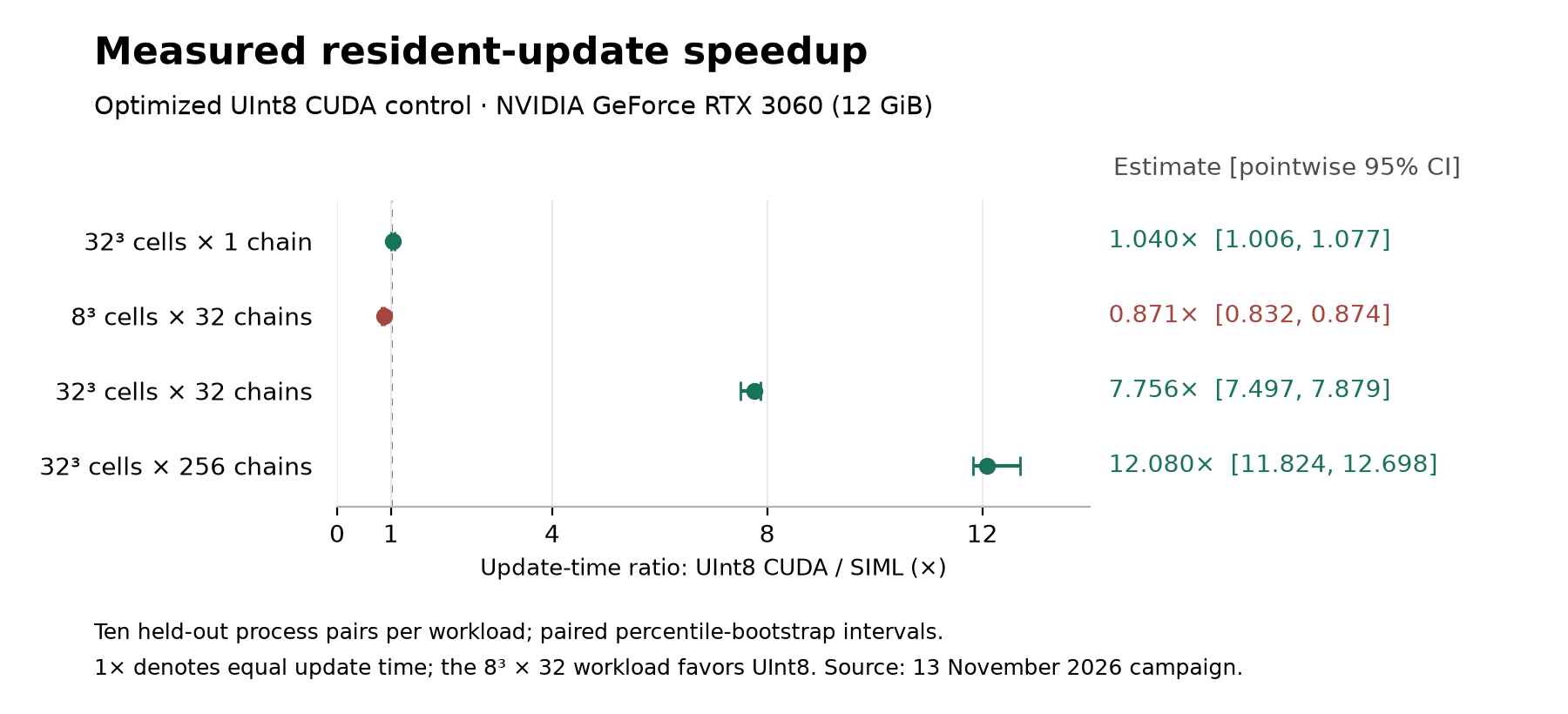
Matched resident-update comparisons from the frozen campaign. Ratios above one favor SIML; the smallest workload favors the UInt8 control. The PDF gives the workload definitions, timing boundaries and pointwise intervals.
Resident-update timing concerns work after setup. Compilation, initialization and initial transfers are separate costs. Updating an already resident population quickly does not establish the speed of a complete application that also loads inputs, observes results and performs other computations.
Capacity requires continuous execution
A large allocation alone would be weak evidence of useful capacity. The capacity campaign therefore requires successful continuous execution, retained measurements and stable observed allocator boundaries for at least 600 measured seconds. Searches use declared device allocation, host memory and compilation budgets, with unsuccessful attempts retained in the internal record.
The connected-lattice result contains exactly 84,258,095,104 binary variables. Its approximately 2.97 sweeps per second describes complete population updates during that sustained run. The ensemble test separately demonstrated 84,166,049,792 variables across 2,568,544 independent lattices. These are demonstrated populations under the experiment's operating budgets. They do not establish the GPU's absolute physical maximum, and capacity results from different backends are not comparisons at equal population.
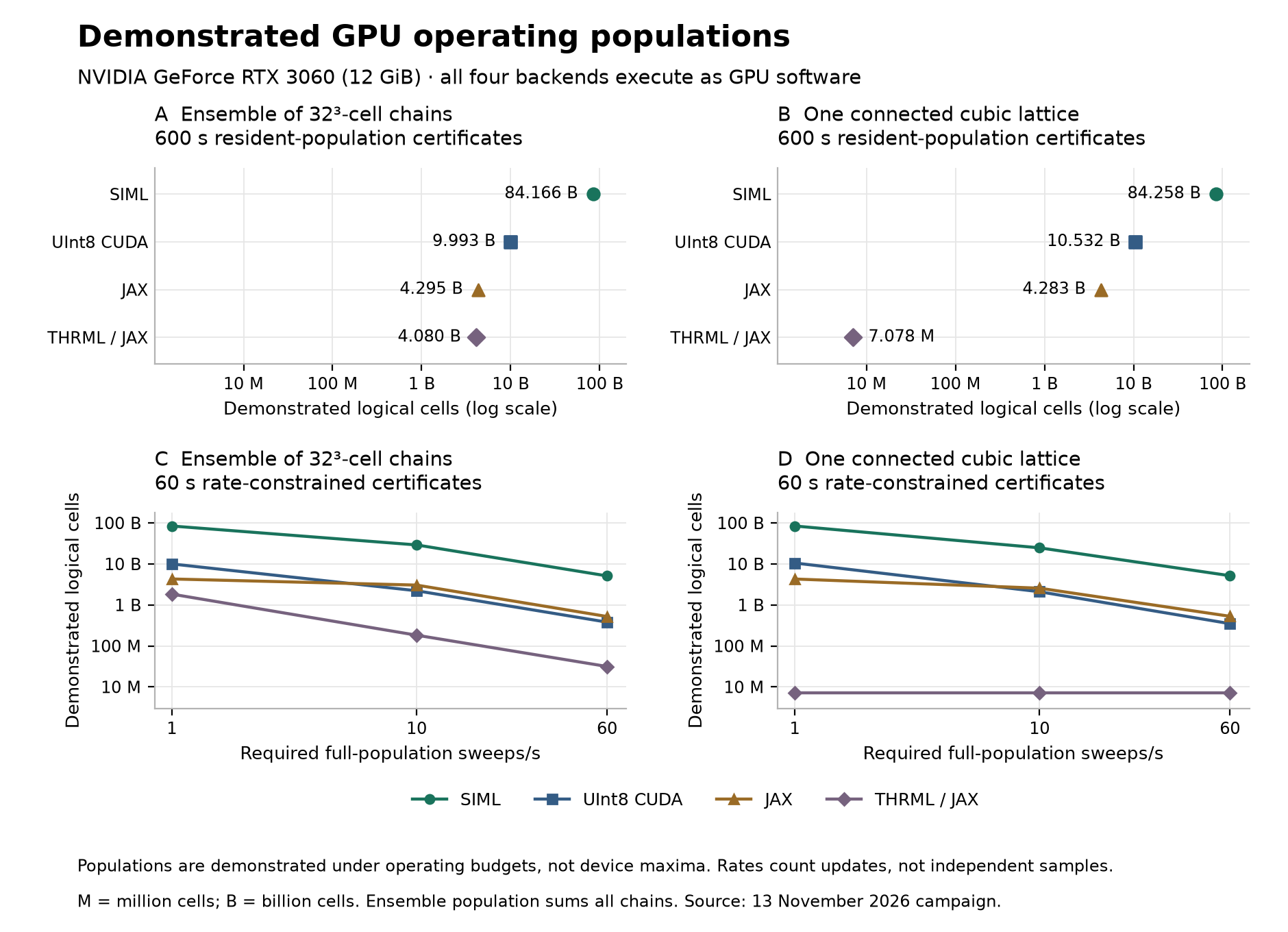
Capacity certification is separate from the matched speed experiment. Each shown population passed its own sustained execution check; its update rate belongs to that population.
The limits belong with the results
The smallest matched case, 32 lattices of side eight, favored the UInt8 CUDA control. A separate exploratory tuning follow-up also retained that loss. The study does not isolate why the control wins at that size and does not support a universal acceleration claim.
Correctness fixtures check small declared targets and independence cases. They do not establish complete posterior accuracy for the largest non-enumerable lattices. A sweep is an update count, not an independent posterior sample. Convergence, autocorrelation and effective independent sampling require their own measurements.
JAX and THRML comparisons execute software on the GPU; no physical Extropic chip was tested. The campaign measures neither energy savings nor biochemical validity. It does not demonstrate chemical kinetics, pKa predictions, arbitrary reaction networks or general Free Energy Principle acceleration.
Publication and next questions
Read the full white paper (PDF).
This release documents the completed evidence from experiments 012–014, with the resident and capacity campaigns frozen on 13 November 2026. Later library and chemical primitives require separate validation and are outside these results. The PDF presents the target, benchmark method, measurements, uncertainty and limitations while keeping implementation details private. Independent reproduction of the proprietary implementation is therefore unavailable through this release.
The next questions are how the measured advantage changes across hardware, observation schedules and more varied targets. Read our research approach or contact Deep SIML Labs to discuss evaluation or collaboration.