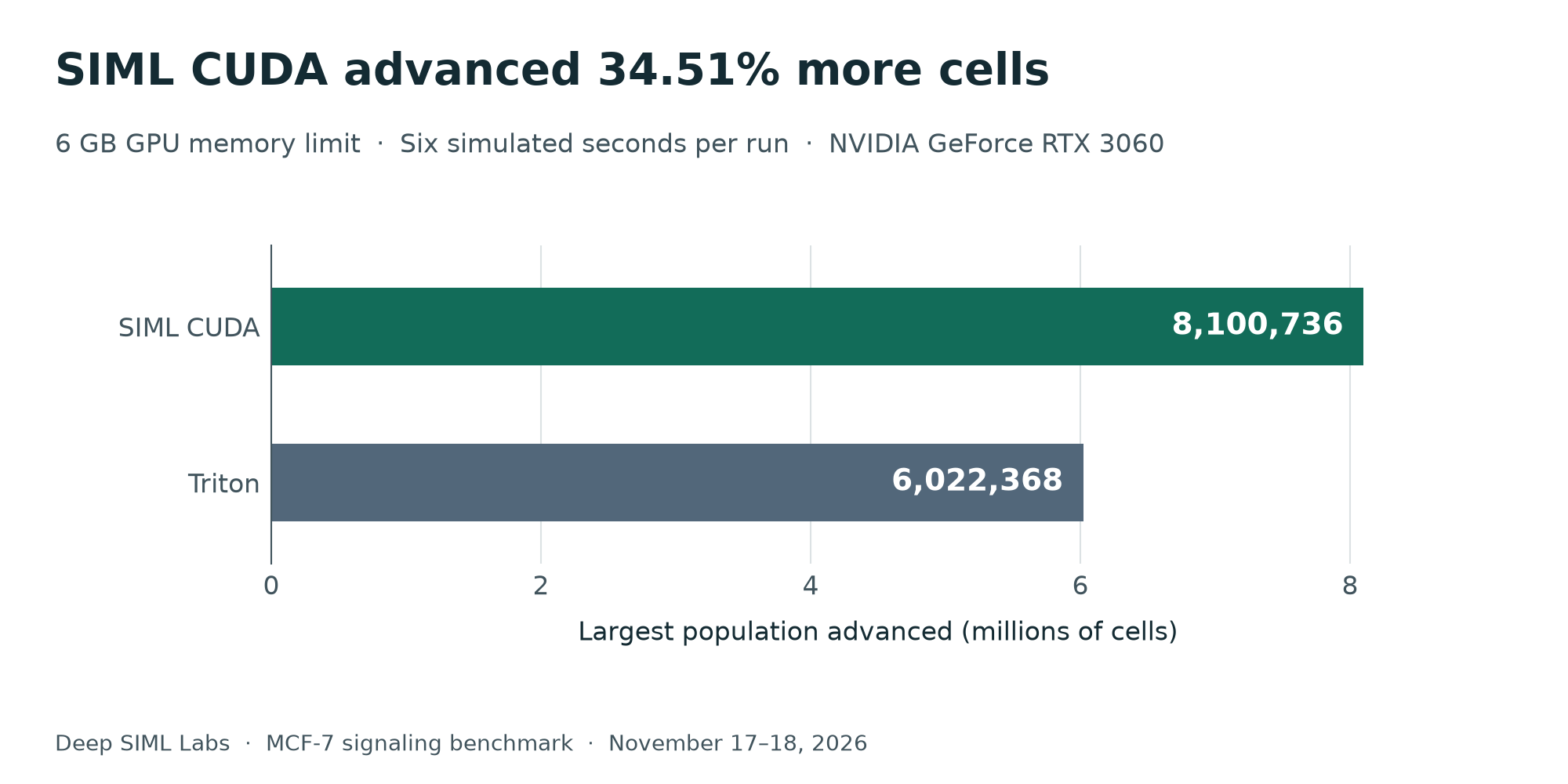
With the same 6 GB of GPU memory available to both systems, SIML CUDA simulated 2,078,368 more interacting cells than Triton. We used the open-source Triton GPU programming language for the baseline and ran both implementations on a single NVIDIA GeForce RTX 3060. SIML CUDA advanced 8,100,736 cells through six simulated seconds. Triton advanced 6,022,368 cells through the same interval. That is a 34.51% increase in demonstrated population for this model and these settings.
What counts as a simulated cell?
Each simulated cell is one patch in a line, with reactions modeled on signaling in cultured human MCF-7 cells. The benchmark follows 116 molecular states and 102 reactions per patch. Neighboring patches exchange two extracellular signals, EGF and heregulin. Adding cells extends this interacting population while preserving the biological detail in every patch. The reaction equations come from the published ErbB signaling model. Birtwistle et al. · BioModels record
We held the starting conditions, model, accuracy requirements and memory limit fixed across implementations. A population counted toward capacity only after all six simulated seconds passed the numerical checks. At each system’s limit, the next test added 32 cells and exceeded the memory allowance.
Time and memory at the same population
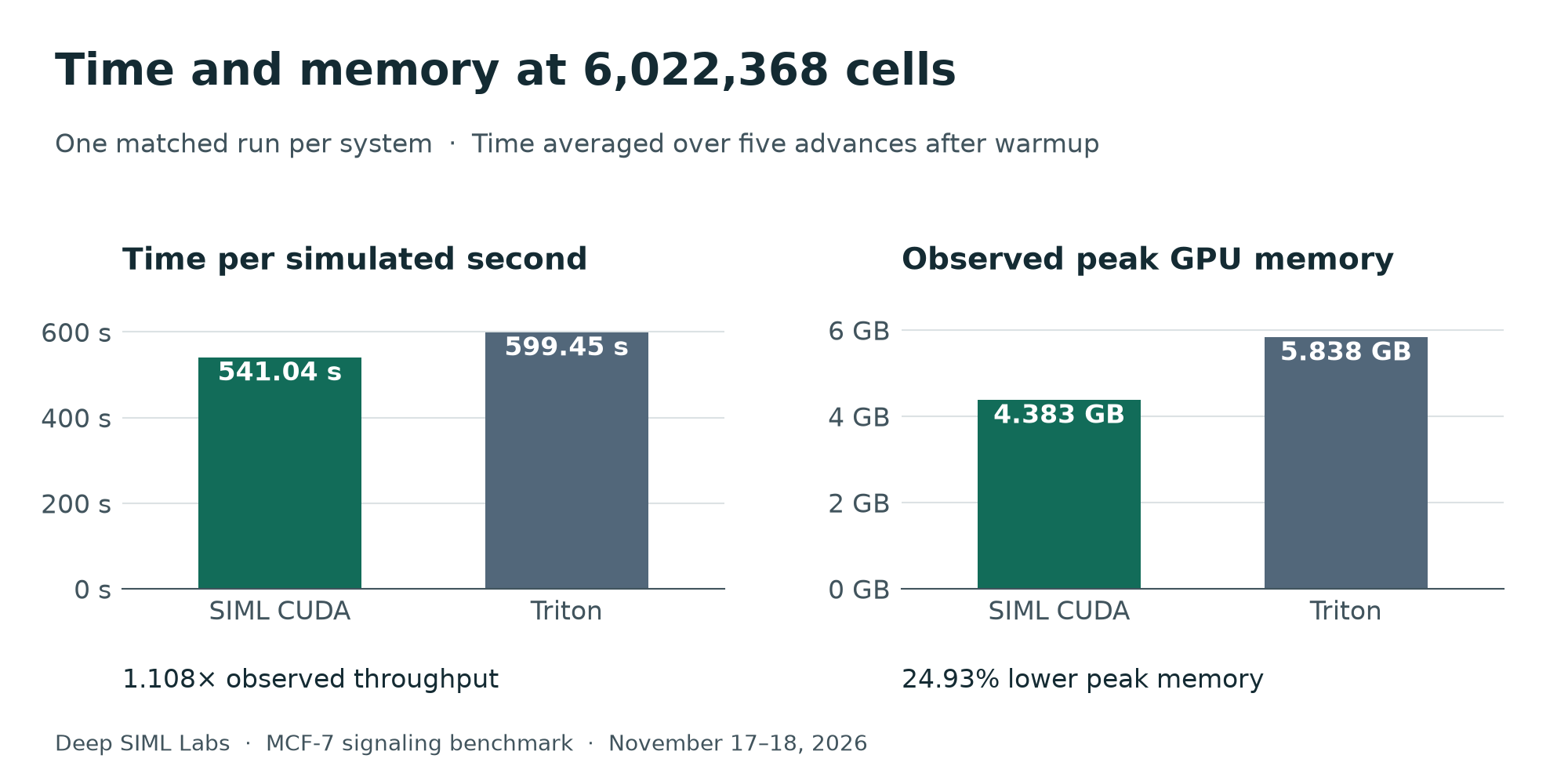
At 6,022,368 cells, Triton used 5.838 GB at its observed peak. SIML CUDA used 4.383 GB, saving 1.455 GB (24.93%) while advancing the same population.
The first simulated second took about 3.72 hours with SIML CUDA and 4.10 hours with Triton. Over the next five, SIML CUDA averaged 541.04 wall seconds per simulated second and Triton averaged 599.45. That gives SIML CUDA 1.108× the observed throughput after the first second. This comparison used one paired run. Repeated independent runs at this population would be needed to estimate uncertainty in the speed ratio.
Accuracy and scope
Both implementations first passed reference comparisons on six interacting cells over 20 simulated seconds across 32 held-out initializations. At the larger populations we checked conservation across the whole field and compared reaction rates with a high-precision reference at sampled cells. The two implementations also passed an endpoint comparison at 16 sampled locations in the shared population.
For research groups budgeting GPU memory, the measured gain is room for about two million additional cells at the same molecular detail. The capacity result covers one GPU, one starting population pattern and one spatial arrangement over six simulated seconds. The technical whitepaper (PDF) gives the measurement protocol and the limits of the comparison. This study has not undergone peer review.
To discuss an evaluation with your own model or GPU budget, contact Deep SIML Labs.